

In our 628th issue:
A Blight on the Constitution: Congress Approves More Warrantless Wiretapping
As 2012 came to a close, the Senate shamefully approved a
five-year extension to the FISA Amendments Act, an unconsitutional law
that openly allows for warrantless surveillance of Americans' overseas
communications. Despite a powerful speech by Senator Ron Wyden explaining the privacy dangers and the lack of oversight in the extended law,
the Senate rejected all the proposed amendments that would have brought
a modicum of transparency and oversight to the government's activities.
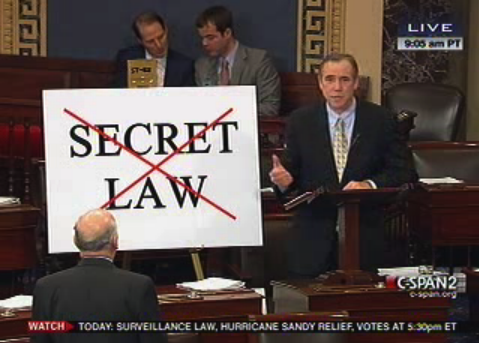
Senator Jeff Merkley urges his colleagues to reject secret laws during the 2012 FISA Amendments Act debate.
EFF and ACLU Successfully Oppose Speech-Chilling Twitter Subpoenas
The San Francisco District Attorney was recently forced to cut
short a Twitter "fishing expedition." The office had issued a pair of
subpoenas issued to Twitter, seeking tweets, photos, and a trove of
other information related to the accounts of two activists charged with a
number of offenses stemming from a Columbus Day anti-capitalist
protest. After EFF and ACLU got involved, the DA wisely cut bait.
Scanning Documents? Patent Trolls Want You To Pay Up
Though 2012 brought us some much needed movement toward patent
reform, it is clear that 2013 promises to provide many of the same
patent troll follies of which we've already grown tired. For example,
Ars Technica has profiled a particularly atrocious group of patent
trolls who are demanding payments from small businesses for committing
the egregious, shameful act of... scanning documents to email.
Year in Review: 2012 in Digital Rights
These articles are selections from our annual year-end review
series, covering topics as they developed over the preceding year. For
the whole list of topics we reviewed this year, see our full wrap-up post.
The "first sale" doctrine expresses one of the most important
limitations on the reach of copyright law. The idea is simple: once
you've acquired a lawfully-made CD or book or DVD, you can lend, sell,
or give it away without having to get permission from the copyright
owner. But the copyright industries have never liked first sale, since
it creates competition for their titles (you could borrow the book from a
friend, pick it up at a library, or buy it from a used book seller on
Amazon). Two legal cases now pending could determine the future of the
doctrine.
After years of complaining that our email privacy laws were
hopelessly outdated, 2012 saw a promising beacon of light peek out from
the unlikeliest of places: a sex scandal. The e-mail evidence of former
CIA director David Petraeus' extra-marital affair drew attention to
areas of insufficient legal protection.
This year's fights against Internet TV startup Aereo and the
commercial-skipping DVR created by Dish Network are part of a sordid
tradition of using copyright suits to squelch disruptive innovation.
Fortunately, the innovators have won the first round in both of these
cases, with the courts refusing to shut down these new technologies
ahead of a trial. Both of those preliminary victories are now on appeal —
and EFF will be there.
Coming into 2012, the Internet community was looking down the
barrel of very dangerous legislation that would have silenced legitimate
speech in the name of curbing online "piracy." The House bill called
the Stop Online Piracy Act (SOPA) and its Senate counterpart, the
PROTECT IP Act (PIPA), had been debated, amended, and looked to be on
the fast track for legislative approval. That all changed on January 18.
Given the alarming expansion of state-sponsored surveillance,
it can be hard to find reasons to be optimistic about individuals'
ability to avoid being watched on the web. Yet the continued rise of
HTTPS is a beacon of hope for thwarting many types of surveillance.
miniLinks
A federal judge in Manhattan refused to require the Justice
Department to disclose a memorandum providing the legal justification
for the targeted killing of a United States citizen, who died in a drone
strike in Yemen in 2011.
Head of Kuwait Society for Human Rights has announced that an
opposition member has been delivered a two-year jail sentence after
"insulting the emir."
After landmark protests against legislative proposals in 2012,
the RIAA and MPAA admit copyright enforcement are not on the agenda for
the new Congress.
Supported by Members
Our members make it possible for EFF to bring legal and
technological expertise into crucial battles about online rights.
Whether defending free speech online or challenging unconstitutional
surveillance, your participation makes a difference. Every donation
gives technology users who value freedom online a stronger voice and
more formidable advocate.
If you aren't already, please consider becoming an EFF member today.
Administrivia
Editor: Parker Higgins, Activist
editor@eff.org
editor@eff.org
EFFector is a publication of the Electronic Frontier Foundation.
eff.org
eff.org
Membership & donation queries: membership@eff.org
General EFF, legal, policy, or online resources queries: info@eff.org
Reproduction of this publication in electronic media is encouraged. MiniLinks do not necessarily represent the views of EFF.


No comments:
Post a Comment