 |
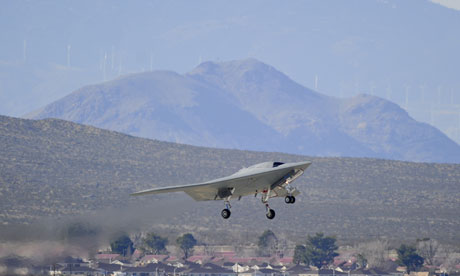
| An unmanned Northrop Grumman X-47B on a test flight at Edwards air force base in California. Photograph: -/AFP/Getty Images |
The rational approach to the inhumanity of automating death by machines beyond the control of human handlers is to prohibit it
by Noel Sharkey
Are we losing our humanity by automating death?
Human Rights Watch (HRW) thinks so. In a new report, co-published with
Harvard Law School's International Human Rights Clinic, they argue the
"case against killer robots".
This is not the stuff of science fiction. The killer robots they refer
to are not Terminator-style cyborgs hellbent on destroying the human
race. There is not even a whiff of
Skynet.
These are the mindless robots
I first warned Guardian readers about in 2007
– robots programmed to independently select targets and kill them. Five
years on from that call for legislation, there is still no
international discussion among state actors, and the proliferation of
precursor technologies continues unchecked.
Now HRW has stepped up
to recommend that all states: prohibit the development, production and
use of fully autonomous weapons through an international legally binding
instrument; and adopt national laws and policies to prohibit the
development, production, and use of fully autonomous weapons.
At the same time the Nobel peace prize winner
Jody Williams has stressed the need
for a pre-emptive civil society campaign to prevent these inhumane new
weapons from creating unjustifiable harm to civilian populations.
By coincidence, three days after the HRW report was published, the US department of defence issued a
directive on "autonomy in weapons systems"
that "once activated, can select and engage targets without further
intervention by a human operator". It "establishes … policy and assigns
responsibilities for the development and use of autonomous and
semi-autonomous functions in weapon systems". But this offers no
comfort.
The US forces and policymakers have been discussing the
development of autonomous weapon systems in their roadmaps since 2004,
and the directive gives developers the green light. It boils down to
saying that the defence department will test everything thoroughly from
development to employment, train their operators, make sure that all
applicable laws are followed; and have human computer interfaces to
abort missions. It also repeatedly stresses the establishment of
guidelines to minimise the probability of failures that could lead to
unintended engagements or loss of control.
The reason for the
repeated stress on failure becomes alarmingly clear in the definitions
section, where we are told that failures "can result from a number of
causes, including, but not limited to, human error, human-machine
interaction failures, malfunctions, communications degradation, software
coding errors, enemy cyber attacks or infiltration into the industrial
supply chain, jamming, spoofing, decoys, other enemy countermeasures or
actions, or unanticipated situations on the battlefield".
These
possible failures show the weakness of the whole enterprise, because
they are mostly outside the control of the developers. Guidance about
human operators being able to terminate engagements is meaningless if
communication is lost, not to mention that the types of
supersonic and hypersonic robot craft the US are developing are far beyond human response times.
There
are other technical naiveties. Testing, verification and validation are
stressed without acknowledging the virtual impossibility of validating
that mobile autonomous weapons will "function as anticipated in
realistic operational environments against adaptive adversaries". How
can a system be fully tested against adaptive unpredictable enemies?
The
directive presents a blinkered US-centric outlook. It lacks
understanding that proliferation of the technology means US robots are
likely to encounter equal technology from other sophisticated powers. As
anyone with a computing background knows, if two or more machines with
unknown programs encounter one another, the outcome is unpredictable and
could create the unforeseeable harm to civilians that HRW is talking
about.
The directive tells us nothing about how these devices will
lower the bar against initiating wars, taking actions short of war or
violating human rights by sending killing machines abroad, where no US
personnel can be injured or killed, to terrify local populations with
uncertainty. Autonomous killers can hover for days waiting to execute
someone.
It is clear that the rational approach to the inhumanity
of automating death by machine is to prohibit it. We are on the brink of
a revolution in military affairs that should and must be stopped.


 BS Alert: “Too Much Manliness” Caused Football Player’s Murder/Suicide
On Saturday, a rich 25-year-old man, Jovan
Belcher, murdered his 22-year-old girlfriend, the mother of his child.
First, columnist Jason Whitlock of Fox Sports suggested that this
“25-year-old kid” wasn’t responsible for his ... READ MORE
BS Alert: “Too Much Manliness” Caused Football Player’s Murder/Suicide
On Saturday, a rich 25-year-old man, Jovan
Belcher, murdered his 22-year-old girlfriend, the mother of his child.
First, columnist Jason Whitlock of Fox Sports suggested that this
“25-year-old kid” wasn’t responsible for his ... READ MORE


