ARTICLES - HOT OFF THE FAGGOT

Reporter Kept In Closet At VP Fundraiser

Drudge: Reporter Confined in Closet During Biden Fundraiser

Amplify’d from www.infowars.com

Drudge Report

March 26, 20111

Staffers with Vice President Joe Biden confined an Orlando Sentinel reporter in a closet this week to keep him from mingling with high-powered guests gathered for a Democratic fundraiser.

Reporter Scott Powers was the designated “pool reporter” for the vice president’s Wednesday visit to the massive Winter Park, Fla., home of developer and philanthropist Alan Ginsburg. The veep hadn’t arrived yet but most of the 150 guests (minimum $500 donation) had. They were busy noshing on caprese crostini with oven-dried mozzarella and basil, rosemary flatbread with grapes honey and gorgonzola cheese and bacon deviled eggs, before a lunch of grilled chicken Caesar and garden vegetable wraps.

Not so for Powers. A “low-level staffer” put Powers in a storage closet and then stood guard outside the door, Powers told the DRUDGE REPORT. “When I’d stick my head out, they’d say, ‘Not yet. We’ll let you know when you can come out.’”

Read more at www.infowars.com
 

Restitution checks for victims dont show

Amplify’d from www.ydr.com

Restitution checks for some York County crime victims never showed up. Here's why

The state's automated system made a mistake. A county official said it's been fixed.
By RICK LEE
Daily Record/Sunday News
York, PA -
The York County Clerk of Courts Office automatically cuts hundreds of checks every month, many as restitution to crime victims.


But Clerk of Courts Don O'Shell discovered last week that not everyone due a restitution check was getting one.


O'Shell was speaking with a representative of the state office that oversees all of the Common Pleas Courts and district justice offices when he noticed a discrepancy.


According to the state, York County disbursed $9.2 million from the clerk's office last year. That money went to the state, the county's general fund and crime victims.


To O'Shell's knowledge, reports in his office said $12.7 million was collected from criminal defendants in the county in 2010. The same amount, or close to it, should have been disbursed, he said.


After some investigation, O'Shell discovered the state-mandated Criminal Court Case Management System, which was implemented to consolidate case tracking, docketing and financial accounting, was not automatically writing checks for victims listed in the system as crime witnesses.


O'Shell said Friday about $300,000 that should have been disbursed to victims instead has been counted monthly as money that was collected. He said the management system had been adding that amount each month to the money that actually was collected, leading to the apparent $3.5 million discrepancy between state and local figures.


O'Shell said his cost and fines staff systematically removed the "crime witness" identifier from the system last week and checks to the previously misidentified victims should be disbursed in April.

Read more at www.ydr.com
 

Police Use Tank To Make an Arrest

Amplify’d from www.infowars.com

Michael S. Rozeff

LewRockwell.com

March 26, 2011

Militarization of police? You bet. Read it for yourself. The suspect was thought to be involved with cockfighting. He was unarmed. There was not a suspicion that he was armed. Not a pure instance, I grant, because actor Steven Seagall was in on this through a contract with the sheriff who did it. That itself is incredible. The rest below quotes the article:

Neighbor Debra Ross was so worried she called 911 and went outside where a nearby home had its windows blown out, was crawling with dozens of SWAT members in full gear, armored vehicles and a bomb robot.

“When the tank came in and pushed the wall over and you see what’s in there, and all it is, is a bunch of chickens,” Ross said.

Read more at www.infowars.com
 

Radioactive Cesium Being Released

Amplify’d from www.prisonplanet.com

The American Dream

March 26, 2011

Why does it seem as though the nuclear crisis in Japan just keeps getting worse with each passing day?  TEPCO has announced that extremely radioactive water is now leakingfrom reactors 1, 2, and 3 at their damaged nuclear complex.  On Thursday, three workers stepped into water in reactor 3 that contained 10,000 times the normal amount of radiation.  Two of the workers experienced significant radiation burns and all three were sent to the hospital.  Authorities have also announced that it is very likely that the containment vessel in reactor 3 has been breached.  That is extremely alarming because reactor 3 is the one that uses plutonium-uranium mixed oxide fuel (“MOX fuel”).  So is plutonium being released into the surrounding environment?  That would be absolutely catastrophic.  But what we know is happening already is quite catastrophic.  According to a recent NewScientist article, radioactive iodine-131 is being released at 73% of the level that it was being released at during the Chernobyl disaster.  But iodine-131 only has a half-life of about 8 days.  According to that same article, radioactive cesium-137 is being released at 60% of the level that it was being released at during the Chernobyl disaster.  Cesium-137 has a half-life of approximately 30 years.  That means that all of this cesium is going to be with us for a very, very long time.

Also, it is important to keep in mind that the Chernobyl disaster only burned for 10 days.

The damaged reactors at Fukushima are still emitting radioactive material and will probably be for quite a while.

In addition, the Fukushima complex contains a whopping 1760 tons of nuclear material.

Chernobyl only contained 180 tons.

So all those that are claiming that the Fukushima disaster could not possibly eclipse the Chernobyl disaster are completely delusional.

Most of the media coverage about the radiation coming from Fukushima in recent days has focused on radioactive iodine, but the truth is that cesium may be the greater threat over the long-term.

The recent article in NewScientist mentioned above described what happens when cesium and iodine enters the human body….

Moreover the human body absorbs iodine and caesium readily. “Essentially all the iodine or caesium inhaled or swallowed crosses into the blood,” says Keith Baverstock, former head of radiation protection for the World Health Organization’s European office, who has studied Chernobyl’s health effects.
Iodine is rapidly absorbed by the thyroid, and leaves only as it decays radioactively, with a half-life of eight days. Caesium is absorbed by muscles, where its half-life of 30 years means that it remains until it is excreted by the body. It takes between 10 and 100 days to excrete half of what has been consumed.

So how much cesium are we talking about?

Well, nobody knows for sure, but Keith Harmon Snow is estimating that eachspent fuel pool at the Fukushima nuclear complex could have 24,000 times the amount of cesium that was produced by the nuclear bomb that the U.S. dropped on Hiroshima at the end of World War 2.

That is a very frightening number if you stop and think about it.

Already there is quite a bit of evidence of cesium contamination across northern Japan.

For example, 25 miles from the Fukushima complex, one batch of a leafy green vegetable known as kukitachin was recently discovered to contain 11 times the legal limit of radioactive iodine and 82 times the legal limit of cesium.

So when the Japanese prime minister calls the situation at Fukushima “very grave and serious” he is perhaps understating things.

Unfortunately, things could become even more serious if reactor 3 starts spewing out significant amounts of plutonium.

A recent CNN article explained why reactor 3 is such a concern….

That reactor is of particular concern, experts have said, because it is the only one at the plant to use a combination of uranium and plutonium fuel, called MOX, that is considered to be more dangerous than the pure uranium fuel used in other reactors.

So why should we be concerned about MOX fuel?  A recent article on the Natural News website described the potential threat this way….

Largely absent from most mainstream media reports on the Fukushima Daiichi nuclear disaster is the fact that a highly-dangerous “mixed-oxide” (MOX) fuel in present in six percent of the fuel rods at the plant’s Unit 3 reactor. Why is MOX a big deal? According to the Nuclear Information Resource Center (NIRS), this plutonium-uranium fuel mixture is far more dangerous than typical enriched uranium — a single milligram (mg) of MOX is as deadly as 2,000,000 mg of normal enriched uranium.

Considering the fact that the half-life of plutonium-239 is approximately 24,000 years, perhaps we should all be taking this crisis a little more seriously.

The crisis at Fukushima is rapidly becoming the biggest nuclear disaster in history.  Hopefully the authorities in Japan will quickly realize that the “Chernobyl solution” is the only solution here.

The longer that Fukushima is allowed to pump radioactive material into the environment the worse it will be for all of us.  Just as with Chernobyl, there are going to be serious global health consequences from this nightmare.

The total extent of the health damage being done by Fukushima will probably never be fully known.  But what we do know is that a whole lot of the radioactive material being pumped out by Fukushima will be with us for a very, very long time.

Read more at www.prisonplanet.com
 

3D Map Of Real-Time Radioactivity

GoogleEarth Based 3D Map Of Real-Time Radioactivity Distribution In Japan; Projected Global Radioactivity Dispersion

Amplify’d from www.prisonplanet.com

Tyler Durden

Zero Hedge

March 26, 2011

Confirming that in a time of instantaneous crowdsourced information distribution and analysis, any attempt by a government to institute an information blackout of any nature is doomed to failure, is the following amazing Google Earth-based 3D interactive map of Geiger readings from Japan. And if that is not enough, the Pachube community has released an extensive selection of crowd-sourced realtime radiation monitoring tools and widgets, focusing on as many Japanese territories as possible. Shortly we are confident all geographical holes will be filled, and every square mile of the affected territories will be mapped out surpassed the government’s “Under Survey” blackout attempts.

Make sure to have the GoogleEarth API set up in advance of checking out the plugin.

GoogleEarth Based 3D Map Of Real Time Radioactivity Distribution In Japan; Projected Global Radioactivity Dispersion  googlemap

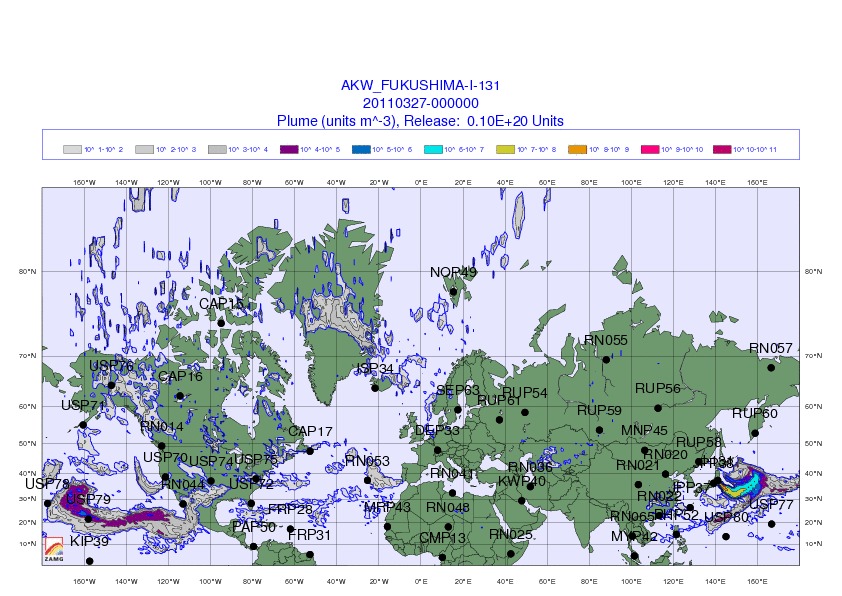
Additionally, here is the most recent updated global radioactive fallout per ZAMG.

GoogleEarth Based 3D Map Of Real Time Radioactivity Distribution In Japan; Projected Global Radioactivity Dispersion  20110325 Reanalyse I131 Bild5 gr

And a complete list of all the available crowdsourced radiation maps, applications and tutorials

h/t Themos Mitsos

Read more at www.prisonplanet.com
 

Lessons to Be Learned from Japan Crisis

Nuke Reboot: Physicists List Lessons to Be Learned from Japan's Nuclear Crisis

For starters, retrofits could make U.S. reactors safer--and maybe even make nuclear power more palatable

Mark I containment at the Browns Ferry Nuclear Plant
STILL SAFE? The Browns Ferry Nuclear Plant in Alabama, where three reactors came online in the 1970s, is one of many U.S. facilities to use the same design as the crippled reactors at Fukushima Daiichi.
Image: TVA
DALLAS—It can't happen here. Or can it?


Many reactors in the U.S. have a similar design to the General Electric units that are spewing radioactive clouds into Japan's skies and keeping the world on edge. So, the U.S. should learn lessons from that ongoing disaster and seriously consider retrofitting at least some of its reactors, Raymond L. Orbach, former undersecretary for science at the U.S. Department of Energy, said here this week at a meeting of the American Physical Society.


"We're trying to learn from Fukushima," said Orbach, who now directs the University of Texas at Austin's Energy Institute.


Orbach and other physicists warned about the current "hysteria"—caused in part by human errors and a lack of transparency on the part of plant owner Tokyo Electric Power Company—and the possible consequences of abandoning nuclear power, such as the environmental impact that would result from producing the same electricity with fossil fuels. Instead, more research and better engineering are called for, he says, adding: "I'm hopeful that cooler heads, wiser heads, will prevail."


Nuclear engineers have long promoted intrinsic safety features that could make future reactors safer, but retrofits at existing nuclear power plants could make intrinsic safety features available at old reactors, too, Orbach said. Such improvements would particularly pertain at 23 reactors in the U.S. that are based on the same 1970s General Electric design as the Fukushima reactors.


For example, one of the worst scenarios at Fukushima would be the release of radioactive material not from the reactor itself but from the pools of water where "spent" fuel is kept. Spent fuel still produces copious heat from its ongoing radioactivity. A failure to refill water lost to evaporation or, worse, from a leak, could lead to a complete boil-off and large releases of radioactive materials into the atmosphere. "They need to figure out a way so that if water level drops, you inject new coolant passively," without the need for pumping, Orbach later told Scientific American in an interview.


Passive cooling systems could be powered by the very heat produced by the spent fuel. Upgrading nuclear plants is expensive, Orbach admitted in his talk, but these plants have long ago paid for themselves and are now producing electricity at a very low cost, which would "seem to have a bit of headroom" for paying for retrofits.


Scott Burnell, a spokesman for the Nuclear Regulatory Commission, says that Mark I reactors have had repeated safety retrofits over the decades, and in particular since 9/11. After the attacks in 2001, "all U.S. plants have incorporated additional resources and procedures to compensate for the possible loss of large areas of the plant due to fires and explosions—these mitigative measures include actions to ensure spent fuel pools are kept cool."


Orbach also called for increased funding for nuclear power research. In a separate presentation here, Robert Rosner, an astrophysicist at the University of Chicago and the former head of the Argonne National Laboratory, pointed out that funding for nuclear energy research precipitously declined between the late 1970s and the late 1990s and has not recovered much since then.


Orbach and Rosner spoke here at a session on nuclear power that had been scheduled long before the world woke up to the new threat at Fukushima Daiichi. With the nuclear crisis still unfolding, the physicists tailored their talks to address issues raised by the crisis in Japan and a predictably renewed wave of public skepticism toward nuclear power.


Rosner cited several arguments in favor of nuclear power. If the U.S. abandoned nuclear power, the nation might end up forfeiting economic opportunities in an industry dominated by a handful of companies that are now reaping profits around the world.


Nuclear energy also provides energy security and diversity with a source that is largely insensitive to fuel price fluctuations and thus to market shocks. "Even if you're anti-nuke," Rosner said, "you might want to think twice about completely abandoning nuclear."


In the absence of any tax on carbon emissions, however, it is hard for nuclear to compete with coal and gas, and therefore "it's very difficult to make economic case for it."
Read more at www.scientificamerican.com
 

Mixed Oxide Nuclear Fuel Raises Concern

MOX Battle: Mixed Oxide Nuclear Fuel Raises Safety Questions

MOX Battle: Mixed Oxide Nuclear Fuel Raises Safety Questions

One of the troubled Fukushima Daiichi reactors contains a blend of uranium and plutonium fuel that may soon find use in the U.S. Does it pose more risks than standard uranium fuel?

Plutonium
MIXED REVIEWS: Plutonium produced for U.S. nuclear weapons is now headed toward use in nuclear power plants as mixed oxide fuel.
Image: U.S. Department of Energy
The nuclear reactors at the Fukushima Daiichi power station in Japan that were crippled by the March 11 earthquake and tsunami are a lot like reactors in the U.S. They are a common, if not exactly modern, General Electric design that harnesses nuclear fission to boil water and drive steam turbines to generate electricity. The same reactor designs and containment system are in use across the U.S., for instance at the Browns Ferry Nuclear Plant near Athens, Ala., and the Vermont Yankee facility in Vernon, Vt.


But reactor No. 3 at Fukushima Daiichi, one of the units that has experienced severe problems in the past two weeks, has one characteristic that differentiates it from its neighboring reactors and from any operating reactor in the U.S. Among the hundreds of standard nuclear fuel assemblies in its core, which rely on the splitting of uranium atoms to release energy, are some that contain a mix of uranium and plutonium. This so-called mixed oxide, or MOX, fuel was loaded into Fukushima Daiichi reactor No. 3 in 2010 and has found use in several other countries' power plants as well. And a big-budget U.S. government project is scheduled to begin producing MOX for domestic utilities in 2016.


But, as with most issues relating to nuclear energy, the use of MOX is a source of some controversy. Proponents say that burning MOX in nuclear reactors is a sensible way to dispose of weapons-grade plutonium from Cold War nuclear stockpiles, as the U.S. plans to do with 34 metric tons of surplus plutonium at its planned Mixed Oxide Fuel Fabrication Facility (MFFF) in South Carolina. (Some countries also reprocess spent nuclear power plant fuel to produce MOX.) Critics say that MOX is riskier than standard fuel and that there are better ways to dispose of excess plutonium.


"I think it's a magnificent solution," says David Jones, senior vice president for the back-end business group at Areva, a Paris-based nuclear fuel manufacturer with U.S. headquarters in Bethesda, Md. Areva is half of a partnership that is the prime contractor to the U.S. Department of Energy (DoE) on the $5-billion MFFF project. "You're taking something that was designed to be dangerous, and you're turning it into something that benefits society," Jones says.


Ordinary low-enriched uranium fuel contains primarily uranium 238, the most common natural isotope of the element, along with about 5 percent uranium 235, a rarer isotope that splits, or fissions, more readily. MOX fuel, on the other hand, substitutes plutonium 239 as the fissionable component, reducing the need for uranium 235.


"It's a fairly well established technology, especially overseas," says Jess Gehin, a nuclear science and engineering researcher at Oak Ridge National Laboratory, where MOX fuel rods have undergone testing. "All of our analyses show that it can be used without significant differences to uranium dioxide."


But Robert Alvarez, a senior scholar at the Institute for Policy Studies, a Washington, D.C., think tank, says that MOX is not the best way to irreversibly render plutonium unsuitable for weapons use. "If you really want to pursue the path of irreversibility, there are probably cheaper, easier ways to do it," he says. One way would be to blend the plutonium down to a low concentration and put it in the DoE's Waste Isolation Pilot Plant in the New Mexico desert. With the price tag attached to the MFFF, "it's certainly not something you'd think you could make money off," Alvarez says. "I kind of see it as a nuclear equivalent to a bridge to nowhere."


And Edwin Lyman, senior scientist for global security at the Union of Concerned Scientists in Washington, D.C., argues that MOX is more likely to cause nuclear accidents than ordinary uranium fuel and is liable to release more harmful material in the event of an accident. "Plutonium has different properties than uranium 235 that generally tend to degrade some of the safety systems in nuclear plants," Lyman says. For instance, because weapons-grade plutonium fissions more readily than uranium 235, reactors may need more robust control rods—neutron absorbers that shut down the nuclear chain reaction when inserted into a reactor's core. "You never get quite as much margin even after doing all that as you do with uranium," Lyman says.


Jones counters that MOX has a proved track record. "You'll hear some folks say that MOX is experimental," he says. "Over 6,000 MOX assemblies have been safely used in reactors around the world." Jones notes that MOX has passed muster with several different regulatory bodies in Europe and Japan, where the fuel has found use in dozens of nuclear power plants. "They found that it does not pose a significant, unacceptable level of risk," he says.


Lyman authored a study in 2001 in Science & Global Security showing that radioactive leakage from a meltdown with MOX fuel, which in addition to plutonium has higher levels of radioactive isotopes such as americium 241 and curium 242, would be deadlier than a low-enriched uranium meltdown. "Because plutonium is so much more radiotoxic than many of the other radionuclides, even if it's released in relatively small concentrations it can have an impact on the effects," Lyman says. He adds that it is not possible at the moment to identify how much the MOX fuel in Fukushima reactor No. 3 has contributed to the radioactive plumes emanating from the plant.


Oak Ridge's Gehin argues that the flavor of nuclear accident is more important than the flavor of fuel in the reactor. "The uncertainty of what would happen [in an accident] is not driven by MOX fuel versus uranium dioxide," he says. "It is driven in what happens in the event itself."


And Jones points out that low-enriched uranium fuel and MOX fuel become more similar as the fuel is consumed in fission reactions. "Folks try to cast a pall over MOX fuel because it has plutonium in it," he says. "We're trying to make sure people understand that uranium fuel, once it goes in the reactor, starts producing plutonium as well as fissioning plutonium and generating energy from it."


Even reactors loaded with straight uranium fuel, such as those in the U.S., end up with a mix of radioactive elements in the core, essentially a lower-plutonium version of MOX. "I don't know why people keep trying to make MOX an issue, because every reactor in the world burns MOX fuel," Jones says. "It goes in as uranium fuel, but once it starts going it has plutonium in it."


Even as the South Carolina fabrication plant progresses toward start up, the future of MOX fuel remains somewhat uncertain in the U.S. "The DoE still can't find a utility that's willing to take this stuff," Alvarez says. Duke Energy had signed an agreement with the DoE to load four of its reactors with MOX fuel, but the utility let the contract lapse in 2008. The federally owned Tennessee Valley Authority (TVA), which operates the Browns Ferry Nuclear Plant and two other nuclear facilities, has expressed some interest in trying MOX and may step up to take fuel from the MFFF. But Lyman questions whether even TVA will be a willing taker. "I don't see why any utility, even a government-owned one like TVA, would want to dabble with this stuff," he says.
Read more at www.scientificamerican.com
 

Incompatible power grids make work hard

Japan's two incompatible power grids make disaster recovery harder

Japan's two incompatible power grids make disaster recovery harder

The huge disaster in Japan has ruined parts of the nation's electrical system, notably the six Fukushima Daiichi reactors that remain shut down. As a result, the country's utilities can't generate enough power to meet demand, so they are using rolling blackouts to give some power to everyone for some portion of each day. That tactic is crippling industry—it's hard to run a factory that makes cars or TVs when the power suddenly cuts out for a few hours each day. The blackouts complicate commuting, so workers can't get to their shifts on time, which further cripples manufacturing. And so on.

Incredibly, the southwestern half of Japan, which largely survived the earthquake and tsunami unscathed, cannot help the northeastern half of the nation, which took the brunt of the damage, because the two sections of the country operate on two separate power grids that are incompatible. As NPR reported on March 24, the southwestern section can actually produce surplus power, but the transmission and distribution system there operates at 60 Hertz, and the northeastern region's grid operates at 50 Hz. This awkward situation, seen clearly on the Japanese map above (blue is 60 Hz, red is 50 Hz), is the legacy of a historic oddity: the "east," as it's referred to in Japan, built its grid based on the German 50 Hz system, and the "west" followed the American 60 Hz system. (An English adaptation of a similar map is here.)

Converting power from one system to the other is a complex task that requires enormous yet highly sensitive machinery. The country has only a few, meager "interconnect" facilities that can do the job, which have nowhere near the capacity to minimize the need for rolling blackouts.

The U.S. has a less dramatic but similarly tenuous setup. The nation is divided into three grids. All three operate at 60 Hz, but again, only a few interconnects exist between the regions. Those sites would have to be beefed up significantly if the country was to benefit from building massive wind farms in the windy high plains or big solar farms in the sunny southwest. More and larger interconnects would also allow regions to "wheel" large quantifies of power between them, to help minimize blackouts caused by storms. Better interconnects would also help utilities that might be in danger of exceeding their capacity (say, Texas, buckling under heavy air conditioning load in August) to get some extra power from another region that has some to spare (perhaps cool Minnesota on that same day).

Map courtesy of Tosaka, via WikiMedia Commons

Read more at www.scientificamerican.com
 

Radiation fears mount again

Radiation fears mount again in Japan after plant workers hurt

Radiation fears escalated inJapan on Friday after workers suffered burns as they tried tocool an earthquake-crippled nuclear power station, while thegovernment sowed confusion over whether it was widening anevacuation zone around the plant.

Reuters

By Mayumi Negishi and Kazunori Takada

TOKYO, March 25 (Reuters) - Radiation fears escalated in

Japan on Friday after workers suffered burns as they tried to

cool an earthquake-crippled nuclear power station, while the

government sowed confusion over whether it was widening an

evacuation zone around the plant.

Prime Minister Naoto Kan, making his first public statement

on the crisis in a week, said the situation at the Fukushima

nuclear complex north of Tokyo was "nowhere near the point" of

being resolved.

"We are making efforts to prevent it from getting worse, but

I feel we cannot become complacent," he told reporters. "We must

continue to be on our guard."

The comments reflected a spike of unease in Japan after

several days of slow but steady progress in containing the

nuclear accident, which was triggered by a devastating

earthquake and tsunami two weeks ago.

The 9.0 magnitude quake and giant waves it triggered left

more than 10,000 people dead and 17,500 missing.

As shocking as that toll is, much attention since the March

11 disaster has been on the possibility of a catastrophic

meltdown at Fukushima, 240 km (150 miles) north of Tokyo.

The government prodded tens of thousands of

people living in a 20 km-30 km (12-18 mile) zone beyond the

stricken complex to leave, but insisted it was not widening a 20

km evacuation zone.

China, meanwhile, said two Japanese travellers arriving in

the country were found to have very high levels of radiation.

Three workers trying to cool one of the most critical

reactors at the plant were exposed to radiation levels 10,000

times higher than normal, raising the possibility of a leak of

radioactive material through a crack in the core's container.

That would mean a serious reversal following slow progress

in getting the plant back under control.

The reactor, No. 3 of six, is the only one to use plutonium

in its fuel mix which is more toxic than the uranium used in the

other reactors. The government called for an investigation into

why such high levels of radiation had suddenly appeared.

More than 700 engineers have been working in shifts to

stabilise the plant but they pulled back from some parts when

the workers were hurt on Thursday. Two of the men suffered

radiation burns when contaminated water seeped over their

shoes .

Nuclear agency official Hidehiko Nishiyama said there was a

possibility of damage to the reactor but he later told

reporters: "It could be from venting operations and there could

be some water leakage from pipes or from valves, but there is no

data suggesting a crack."

Hideo Morimoto, director at the Agency for Natural Resources

and Energy, also played down fears.

"I feel if the pressure vessel has been seriously damaged,

then far more radiation would have leaked," he said.

U.N. nuclear watchdog IAEA said a total of 17 workers had

received elevated levels of radiation since the operations

began, but the other 14 did not suffer burns.

Two of the reactors are now seen as safe but the other

four are volatile, occasionally emitting steam and smoke. But

work is advancing to restart water pumps to cool their fuel

rods.

Authorities have been using seawater to cool the

rectors but that is not ideal as it corrosive and leaves salt

deposits that constrict the amount of water that can cool the

rods.

Plant operator Tokyo Electric Power Co (TEPCO)

said it started injecting freshwater into the pressure vessels

of reactors No.1 and No.3 and expected to start injecting

freshwater into No. 2 soon.

The United States has offered to help with two barges

with 525,000 gallons (2.0 million litres) of freshwater.

RADIATION IN TRAVELLERS

Chinese authorities said two travellers who arrived in the

eastern city of Wuxi from Tokyo were found to have levels of

radiation that "seriously exceeded the limit" although they

presented no risk to others.

Up to now, no one in Japan except workers at the stricken

plant has been found with seriously elevated radiation levels,

and departing airline passengers are not being screened.

Japan's chief cabinet secretary said 130,000 people living

in an outer circle around Fukushima should consider leaving,

although he insisted it was because of the difficulties

in getting them supplies and was not an evacuation order.

"Given how prolonged the situation has become, we think it

would be desirable for people to voluntarily evacuate," Yukio

Edano said.

Japan cleared about 70,000 people from a 20-km (12-mile)

zone around the plant soon after the earthquake and tsunami.

Edano has maintained there was no need to expand the

evacuation zone, but an official at the Science Ministry

confirmed that daily radiation levels in an area 30 km (18

miles) northwest of the plant had exceeded the annual limit.

FEAR OVER FOOD

Alarm about radiation is spreading at home and beyond.

Vegetable and milk shipments from near the plant have been

stopped, and Tokyo's 13 million residents were told this week

not to give tap water to babies after contamination from rain

put radiation at twice the safety level.

It dropped back to safe levels the next day, and the city

governor cheerily drank tap water in front of cameras.

Experts say radiation from the plant is still generally

below levels of exposure from flights or medical X-rays.

Nevertheless, South Korea, Taiwan, Singapore, Australia, the

United States and Hong Kong are restricting food and milk

imports from the zone. Other nations are screening Japanese

food, and German shipping lines are simply avoiding the country.

In Japan's north, more than a quarter of a million people

are in shelters. Exhausted rescuers are still sifting through

the wreckage of towns and villages, retrieving bodies.

Amid the suffering, though, there was a sense that Japan was

turning the corner. Aid flowed to refugees, and phone,

electricity, postal and bank services have resumed, though the

can still be patchy.

Owners of small businesses have begun cleaning up.

"Everybody on this block has the firm belief that they are

going to bring this thing back again," said Maro Kariya in the

town of Kamaishi, as he cleared debris from a family coffee

shop.

The estimated $300 billion damage makes it the world's

costliest natural disaster. Global financial market jitters over

the crisis have calmed, though supply disruptions are affecting

the automobile and technology sectors.

Foreigner investor buying of Japanese shares actually

reached a record high in the week after the disaster, data

showed, as bargain-hunters jumped in on an initial plunge.

(Additional reporting by Linda Sieg, Chizu Nomiyama, Sumio Ito,

Shinichi Saoshiro and Kiyoshi Takenaka in Tokyo, Yoko Nishikawa,

Jon Herskovitz and Chisa Fujioka in northeast Japan; Writing by

Robert Birsel; Editing by John Chalmers)

Read more at www.scientificamerican.com
 

The Effects of Chernobyl

Amplify’d from theintelhub.com

The Effects of Chernobyl

Wikipedia – The Chernobyl disaster triggered the release of substantial amounts of radiation into the atmosphere in the form of both particle and gaseous radioisotopes, and is the most significant unintentional release of radiation into the environment to date. It has been suggested that the Chernobyl disaster released as much as 400 times the radioactive contamination of the Atomic bombings of Hiroshima and Nagasaki.[citation needed] However, the work of the Scientific Committee on Problems of the Environment (SCOPE) suggests that the two events cannot be simply compared with a number suggesting that one was x times larger than the other; the isotopes released at Chernobyl tended to be longer-lived than those released by a bomb detonation, producing radioactivity curves that vary in shape as well as size.

Note: This video contains graphic content. Viewer discretion is advised.

See more at theintelhub.com